
The Centre for Monitoring Indian Economy on Tuesday said industrial production growth is likely to decline in the second half of the current fiscal, while the first advanced estimate of kharif crop showed a 10 per cent drop in food production.\n\n\n\n
Driven by erratic monsoon and higher global crude prices, inflation is likely to grow by 5.7 per cent in the current fiscal ending March 2006, according to the Centre for Monitoring Indian Economy.

Reserve Bank Governor Shaktikanta Das on Monday said with the country's foreign exchange reserves at $677 billion, it is comfortably placed to deal with any spillover effects and for financing of the current account deficit. Over the last three years, the country's foreign exchange reserves have surged by $270 billion. He said as per the latest data, the foreign exchange reserves are $622 billion.

'Congress leaders who are making strategy for the Congress to win elections have not even won a class monitor elections.' 'When you have not contested school monitor elections, what will you know about the ground reality?'
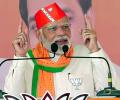
Congress spokesperson Abhishek Manu Singhvi cited a viral video on social media platforms, claiming that in it Modi's voice is heard in a call with BJP rebel Kripal Parmar.
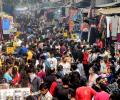
'It is entering growth territory on a month-on-month basis.'

'Nobody is talking about the inequality that is going to come.'

"India has become the fastest growing major economy in the world. Despite the global slowdown, we have registered excellent growth. Today, India is a bright spot in the global economy. We are seen as the engine of global growth," he said.

'Investors should ideally consider equity allocations from a medium-to-long term perspective.'

A business in India wanting access to maps and geospatial data would typically have to wait months before it got what it wanted. All this is set to change with the new guidelines on geospatial data, report Neha Alawadhi and Peerzada Abrar.

A look at six indicators shows all of them have collapsed from positive growth in April to contraction in September.
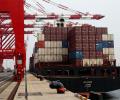
Container prices have shot up by up to 300 per cent in the past one month owing to geopolitical tensions between Israel and Iran following the former's attack on Hamas, causing shortages and pushing consumer durables companies to increase prices. Companies have planned increases but some are yet to decide on the extent of the increase.
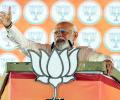
In nearly 100 seats, the BJP stands almost no chance of winning. In 200 seats, it is a direct fight between the BJP and the Congress where the BJP has an upper hand. In 243 seats, the BJP is pitted against regional parties and it is not going to be easy. That is why 400 seats may end up as a pipe dream, states Ramesh Menon, author of Modi Demystified: The Making of a Prime Minister.

Expenditure on new projects slowed down for the second quarter in a row amid an uncertain global environment and higher borrowing costs. There were new projects worth a cumulative Rs 3.26 trillion in the July-September period, according to data provided by project tracker Centre for Monitoring Indian Economy (CMIE). This figure is much less than Rs 4.39 trillion in the June quarter (Q1FY23) and Rs 8.46 trillion in the March quarter (Q4FY22).

The country's unemployment rate in July fell to 6.80 per cent, the lowest level in the last six months, amid rising agriculture activities during monsoon, according to Centre for Monitoring Indian Economy (CMIE) data. The unemployment rate dropped to 6.80 per cent in July from 7.80 per cent in June, the CMIE data said. Rural unemployment declined 6.14 per cent to 272.1 million last month from 265.2 million or 8.03 per cent in June, it said.

'The Indian economy and the Indian financial sector today remain resilient and much better placed.'

Urban men lost more jobs than women during the second wave of COVID-19, implying a complete loss of livelihood for millions of households, according to the Centre for Monitoring Indian Economy (CMIE). The most disproportionate loss of jobs because of the first wave of COVID-19 was among urban women, CMIE's MD and CEO Mahesh Vyas said in his analysis. He said urban women account for about three per cent of total employment, but they accounted for 39 per cent of total job losses in the first wave of the pandemic.
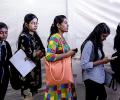
Go beyond the curriculum. Talk to experts. Build your network, says Dr NV Raghavendra.

India must be prepared to deal with climate disasters, geopolitical confrontations, and social strife linked to global events, asserts Jayant Sinha, chairman of Parliament's Standing Committee on Finance.

'I think some of us, like Mukesh Ambani, myself and those of us who head industrial units, ought to really focus on what we can really do to make the world a safer place, maybe 50 or 100 years from now.' 'For instance, how can we deal with climate change and global warming, right now?' 'The effects of it may not be felt now; in fact, we may pay a price for it today, but it will help the generations to follow.'

'Focus on 19,400/64,900 as the key resistance levels for the Nifty/Sensex.'

'We have essentially tried to set out an agenda for the next five years and it, in essence, represents the political commitment to that agenda.'

It was women who unambiguously bore the brunt of the lockdown joblessness, says Kanika Datta.

'Even for operational buildings, we are looking to smarten them in various ways.'

Nearly 3.64 lakh educated and "semi-educated" youngsters had registered with employment exchanges across Gujarat till December 2021, according to state government data.

New projects fell 6.3 per cent in the December quarter compared with the September quarter. The value of new projects in the just-concluded quarter was Rs 2.1 trillion, according to the data from Centre for Monitoring Indian Economy (CMIE), which was lower than the Rs 2.2 trillion seen in the September quarter. It is, however, higher than Rs 1.5 trillion recorded for the quarter ended December 2020, the first year of the Covid-19 pandemic. This data ties in with the November data for core sector growth, an index of eight core industries, which grew at its slowest pace since early 2021.
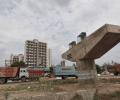
These could include strengthening the public-private partnership (PPP) dispute resolution mechanism, uniform PPP institutional framework, easier terms for infrastructure companies accessing bond markets, and tax sops, Business Standard has learnt. Investment in infrastructure projects with high multiplier effect has been the Centre's main plank to revive the economy, create employment and boost consumption.
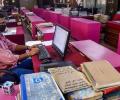
India's services sector activities touched the highest mark since April 2011 amid ongoing improvements in demand conditions, even as cost pressures in the service economy remained stubbornly high, a monthly survey said on Tuesday. The seasonally adjusted S&P Global India Services PMI Business Activity Index rose from 58.9 in May to 59.2 in June -- its highest mark since April 2011. For the eleventh straight month, the services sector witnessed an expansion in output. In Purchasing Managers' Index (PMI) parlance, a print above 50 means expansion while a score below 50 denotes contraction.

India, the US and 12 other members of the IPEF grouping have signed a supply chain resilience agreement that would help mitigate risks of economic disruptions from supply chain shocks and improve crisis coordination. The agreement would help member countries like India to reduce their dependence on China and provide timely information to the IPEF member countries about potential supply disruptions. The COVID outbreak severely disrupted the global supply chain, as most countries were dependent on China for various products like pharma raw materials.
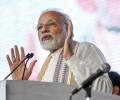
Modi said his government was committed to provide equal opportunities to all sections of the society.

'The term 'pro-growth' must be qualified somewhat because, while a rising tide will lift all boats, it will not necessarily do so equally.'

The only real solution to the jobs crisis, whether in India or abroad, is to direct tech innovation towards job enhancing sectors, and disincentivising job-replacing ones, observes R Jagannathan.

Amphibious drones for maritime inspection... devices that extract pure oxygen from water for patients in need... self-balancing electric bikes...
The trio, 'twin shocks' of demonetisation and GST, 'twin balance sheet' problem that has been weakening India's banking system and the 'twin deficit' problem will continue to challenge economic management and performance in the year ahead, says Shankar Acharya.

While the lockdown hit employment in all age groups, it hit the employment of youngsters who are less than 29 years of age much more. The lockdown also hit women more than it has affected men, reveals Mahesh Vyas.

'The jobs that are being created now are the delivery boy jobs which are of extremely poor quality, or contractual jobs where you hire a person on a per piece basis.'

The rate of unemployment was the highest in the urban areas, which constitute the most number of red zones due to the COVID-19 cases, at 29.22 per cent, as against 26.69 per cent for the rural areas.

The banking regulator was uncomfortable with the runaway pace at which consumer credit was growing.

In his address after more than 75,000 people were given appointment letters for various government jobs in the first tranche, Modi acknowledged the challenges facing the economy the world over with many countries hit by a record inflation and unemployment and said India is making every effort to come out of the situation unscathed.
Unemployment was worse only in the pre-demonetisation period, according to the data, at 9.6 per cent in August 2016.
